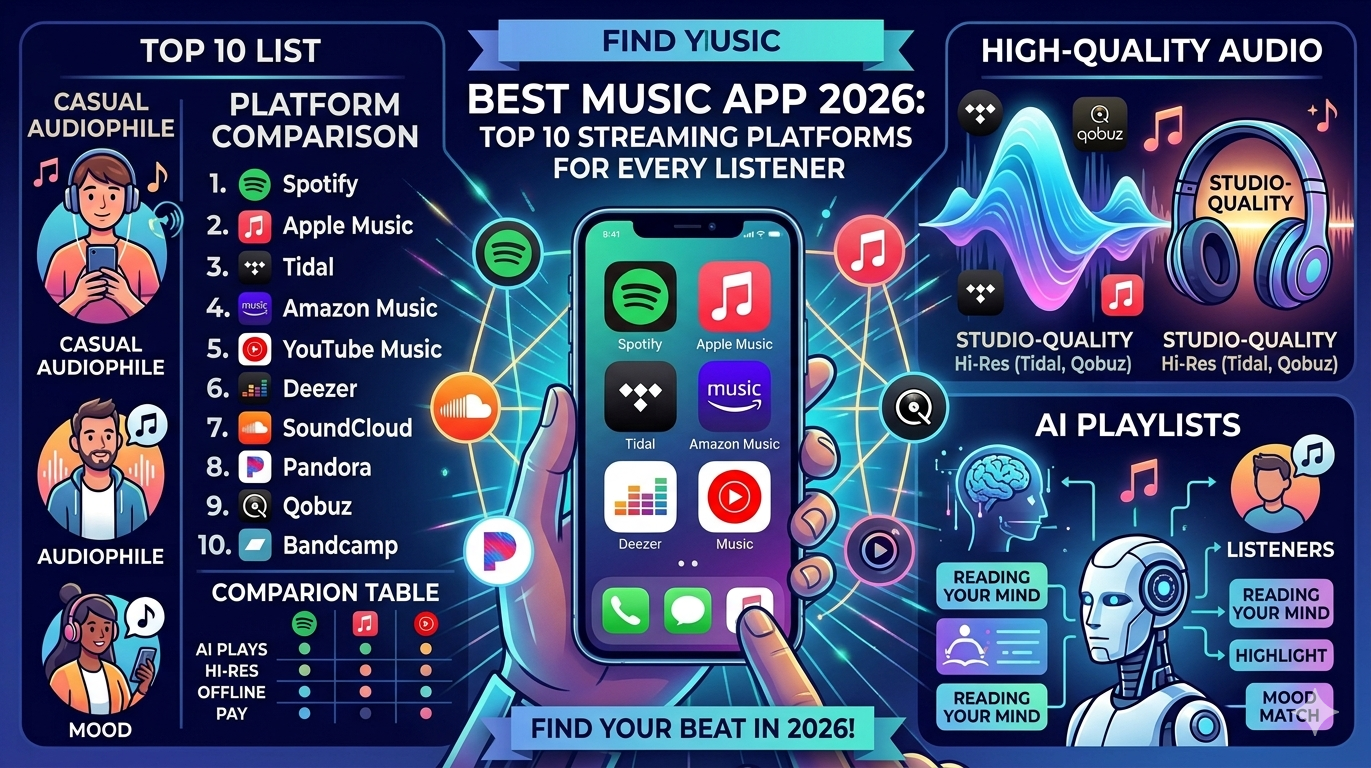
Have you ever sat down, opened a music app, and felt like the songs were actually reading your mind? It’s a great feeling! In 2026, listening to your favorite tunes is easier than ever. Whether you are a casual listener who wants a background beat for chores or an audiophile seeking “studio-quality” sound, there is a perfect platform waiting for you.
Choosing a music app isn’t just about clicking play anymore. It’s about how the AI understands your mood, how clear the singer’s voice sounds, and even how much the artists get paid. With so many options like Spotify, Apple Music, and Tidal, the “best” one depends entirely on what you value most. Let’s dive into the world of digital melodies and find your new favorite way to listen!
What Makes a Great Music App?
A truly great music app needs to do more than just store songs. It should feel like a personal DJ that knows exactly what you want to hear next. The best platforms today focus on “user experience,” which is just a fancy way of saying they are easy and fun to use. You want a clean design, fast search results, and buttons that make sense.
Beyond the looks, we have to talk about the library. Most big apps now have over 100 million songs. That is more music than you could listen to in a thousand lifetimes! But size isn’t everything. A top-tier music app also includes podcasts, audiobooks, and even live concert videos. It becomes a one-stop shop for everything you want to hear.
Comparison of Top Music Platforms (2026)
| Feature | Spotify | Apple Music | Amazon Music | Tidal | YouTube Music |
| Best For | Discovery & AI | Apple Users | Smart Homes | Audiophiles | Video Lovers |
| Audio Quality | High (Lossless) | Hi-Res Lossless | Ultra HD | Master Quality | Standard |
| Offline Mode | Yes | Yes | Yes | Yes | Yes |
| Price (Avg) | $11.99/mo | $10.99/mo | $9.99 (Prime) | $10.99/mo | $10.99/mo |
The Power of Personalized Playlists
The coolest thing about a modern music app is the personalization. Have you noticed the “Discover Weekly” or “Made For You” sections? These use advanced algorithms to track what you skip and what you repeat. In 2026, AI has become so smart that it can even suggest music based on the weather outside or your heart rate from your smartwatch!
I remember when I first used an AI-powered music app. I was feeling a bit down, and without me saying a word, the app suggested a “Moody Morning” playlist that was exactly what I needed. That kind of connection makes the technology feel more human and less like a computer program.
Why High-Quality Audio Matters
If you are using basic earbuds, you might not notice a difference. But if you have good headphones, a high-quality music app is a game changer. We call this “Lossless Audio” or “Hi-Res Sound.” It means the music hasn’t been squashed down to fit into a small file. You hear every breath the singer takes and every pluck of the guitar string.
In 2026, platforms like Tidal and Apple Music lead the way in sound quality. Using a music app that supports “Spatial Audio” makes it feel like the band is standing right in the room with you. It’s an immersive experience that turns a simple song into a private concert.
Listening Without the Internet (Offline Mode)
We’ve all been there—on a plane or in a tunnel with zero bars of signal. This is where the offline feature of your music app saves the day. Most premium subscriptions allow you to download thousands of songs directly to your phone. This means the music never stops, even if the Wi-Fi does.
When picking a music app, check how easy it is to manage these downloads. Some apps make it a bit confusing to find your saved files. A good app will let you “Smart Download” your favorite playlists automatically so you’re always prepared for a “dead zone.”
The Rise of Social Music Sharing
Music is better when shared! A modern music app now acts like a social network. You can see what your friends are listening to in real-time or even start a “Jam Session” where everyone adds songs to a live queue. It’s like a digital house party where anyone can be the DJ.
I love sharing my “Yearly Wrapped” stats from my favorite music app. It’s fun to see that I listened to 500 hours of 80s synth-pop! These social features help us find new artists through the people we trust, rather than just relying on a computer’s guess.
Supporting Your Favorite Artists
Did you know that every time you play a song on a music app, the artist gets a tiny bit of money? This is called a “royalty.” Some apps pay more than others. If you want to support independent creators, look for a music app like Bandcamp or Tidal. They often put more money back into the pockets of the people making the music.
Being a conscious listener is important. When you choose a music app that treats artists fairly, you are helping ensure they can keep making the songs you love. It’s a win-win for everyone involved in the “music ecosystem.”
Smart Home and Car Integration
Your music app shouldn’t stay stuck on your phone. In 2026, the best apps connect instantly to your smart speakers, TV, and car. Imagine walking into your kitchen and saying, “Hey, play my workout mix,” and the music starts right where you left off in your headphones.
This “seamless transition” is a huge part of what makes a music app worth the monthly fee. Whether you use CarPlay, Android Auto, or Alexa, your music should follow you everywhere. If an app makes it hard to connect to your devices, it’s probably not the right one for you.
Podcasts and More: The All-in-One Experience
Gone are the days when you needed five different apps for audio. Now, one music app usually handles it all. You can switch from a heavy metal album to a true-crime podcast with one tap. Some platforms even offer “Audiobooks,” giving you even more value for your subscription.
I personally find it very helpful to have my daily news and my favorite “Lo-Fi” beats in the same music app. It keeps my phone screen clean and saves me the trouble of managing multiple accounts and passwords.
User Interface: Keep it Simple!
No one wants to spend ten minutes trying to find the “Shuffle” button. A top-rated music app must be simple to navigate. This is especially important for younger listeners or seniors. Large icons, clear text, and a powerful search bar are the “must-haves” for any interface.
When I test a new music app, I look for how many clicks it takes to reach my “Recently Played” list. If it’s more than two, the app is too complicated! The best technology stays out of the way and lets the music be the star of the show.
Is a Free Music App Worth It?
Most platforms offer a “Free Tier.” This usually means you have to listen to ads every few songs. While it’s a great way to save money, it can ruin the “vibe” of a party or a workout. A paid music app removes those ads and usually unlocks higher sound quality and offline listening.
If you are a heavy listener, the $10 or $11 a month for a premium music app is usually worth it. Think about it—that’s less than the price of two fancy coffees for unlimited access to almost every song ever recorded!
The Future of Music Apps in 2026
What’s next for the humble music app? We are seeing more “Virtual Reality” concerts and “AI-generated” background tracks for sleeping or studying. The technology is moving toward making music a 3D experience that reacts to your environment.
As we look forward, the music app will likely become even more integrated into our lives. We might see “haptic feedback” where your phone vibrates to the beat, or “AR lyrics” that float in front of you through smart glasses. It’s an exciting time to be a music fan!
Frequently Asked Questions
1. Which music app has the best sound quality?
In 2026, Tidal and Apple Music are the leaders. They offer “Hi-Res Lossless” audio that provides the most detail for listeners using high-end headphones.
2. Can I use a music app for free?
Yes! Apps like Spotify and YouTube Music have free versions. However, you will have to listen to advertisements and you usually cannot download songs for offline use.
3. How do I switch my playlists from one music app to another?
There are “transfer tools” like TuneMyMusic or Soundiiz. These services help you move your favorite songs and playlists between platforms so you don’t have to start from scratch.
4. Are podcasts included in my music app subscription?
On most platforms like Spotify and Amazon Music, podcasts are included for free. Some “exclusive” podcasts might require a specific subscription, but general ones are widely available.
5. Does using a music app use a lot of data?
Streaming high-quality music can use quite a bit of data. To save on your phone bill, try to download your songs over Wi-Fi using the “Offline Mode” before you leave the house.
6. Which music app is best for kids?
Spotify Kids and YouTube Kids are great options. They offer “filtered content” that ensures young ears only hear age-appropriate songs and stories.
Conclusion
At the end of the day, the best music app is the one that makes you smile. Whether you love the smart suggestions of Spotify, the crisp sound of Apple Music, or the video integration of YouTube Music, you have amazing choices at your fingertips.
Don’t be afraid to try a few “free trials” to see which interface feels right for you. Your perfect soundtrack is just a download away. So, what are you waiting for? Open up a music app today and let the rhythm take over!
Leave a Reply